Sunday, 17 March 2024

Cognitive Development Theory

 Also, today, putting this video here.

Thinking through ...

Design Principles, learning, and the immediate, personal, 'context-ghost'


Short version of below text

Merill’s First principles of instruction, in particular, the second point “existing knowledge is activated as a foundation for new knowledge“, is really resonating with me as I am conscious of the contextualising that is going on in the back of mind as I read through.

Community of Inquiry reminded me of Vygotsky’s social development theory.
As I read through Robert Gagné’s Nine Steps in the back of my mind I ‘stepped through’ a class I had written. A lesson plan for a 2D animation class. I haven't taught animation for a long time, but it just popped into my head as a comparison when I read through the 9 steps.

Leads me to reflect on the consideration of existing knowledge in the varying aproaches of design principle
s.

Note - may be unreadable. It is a rough draft to capture thoughts. Coming back to edit later.


Design Principles, some little moments that I recognised. 
In particular Merill’s First principles of instruction, while reading through I have in the back of my mind Piaget, Vygotsky and (even) Froebel’s Gifts …some background knowledge of Cognitive Development theory (from an eLearning module I worked on a few years ago). 

This knowledge is helping me to mentally ‘place’ aspects of my learning as I read through these Design Principles. 

Merill’s First principles of instruction second point “existing knowledge is activated as a foundation for new knowledge“ 

Robert Gagné's Nine Steps of Instruction reminds me of Piaget and also Froebel’s Gifts, 

Community of inquiry reminded me of Vygotsky’s social development theory. Which makes me wonder about underlying theories (or context) behind these Design Principles. What was the context for the design principles development and how does this inform…?

 I am also thinking about these design principles and applying them ‘gently’ as I read through, to my experience.
For example, teaching a 2 D animation workshop. 
I read through Robert Gagné’s 9 Steps and mentally ghosted what I had structured in my lesson plan for that/a session. And thought about what I was trying to cover with what I’d structured, and did it align to Gagné’s 9 Steps – feeling it largely did, as that is why it came to mind as a kind of immediate, personal, 'context-ghost' as I read through.

This experience is really described in Merill’s First principles of instruction second point “existing knowledge is activated as a foundation for new knowledge“.

I find myself wanting to shape a blog post into a fugue. Not that clever though. Completely out of time.

By Roland Topor. Paris, France 1938-97


Revisit Bloom's Taxonomy


Revisiting Blooms Taxonomy (2022). This one by University of Utah - 2 Aug 2022.

Now I have context in regard to revised version by Anderson and Krathwohl's published in 2001. (Noteably: noun to verb)

Download University of Utah handout here


The video by Common Sense Education is from 2016. Gives context and focuses on what they term "Bloom's Digital Taxonomy" Duration 4:51mins


Three stills from the video that talk about different iterations and metaphors.


My next step here is to learn more about SOLO and its origins. 

Wednesday, 13 March 2024

Take on me #☺

 Is there a term that sits between epiphany and 'a-ha moment'?

Today's back-of-the-mind quandary. 


ADDIE is something I am looking at and indeed connecting to my knowledge or working thinking around UX and UI. +Agile. 

No time to place all of the frameworks I am exploring here - perhaps this particular post will be edited where I can.

With said 'betweener'-constructed-meaning moments.  ! 

(that last sentence is a bit like a myBib url) 👈 A 'ho-ho' moment, rather than 'a-ha'


Edit: I didn't write what I was thinking about here (perhaps connecting edu processes-thinking to Asimov's books being jettersoned into a streamed appleTV series - a selection of writers with specific writing styles to address certain aspects of (tvseries) story telling - allowing an enormous amount of freedom while still connected with the main concept. The principles of Asimov's Robot Wars books...

I'm tooo busy! leaving this for another time. Should delete - but there's enough to capture something (for me at least!!) #☺

Friday, 11 August 2023

Blooms Taxonomy

Blooms Taxonomy


"Bloom’s Taxonomy is a hierarchical classification of the different levels of thinking, and should be applied when creating course objectives. Course objectives are brief statements that describe what students will be expected to learn by the end of the course. Many instructors have learning objectives when developing a course. However, many instructors do not write learning objectives. The full power of learning objectives is realized when the learning objectives are explicitly stated. Writing clear learning objectives are critical to creating and teaching a course." 

- https://bloomstaxonomy.net/ accessed 12/08/2023

Tuesday, 23 May 2023

Moodle

Staying on top of updates... 


If you are into Moodle you may find time to watch a few clips.

At time of this post: Moodle is at version 4.2. See their YouTube clip on updates here or

Moodle New Features May 2023. Including information on the following:

Course page improvements

  • Admin setting to control indentation in courses
  • Duplicate course sections
  • Permalink for easy linking to sections
  • Add activities anywhere
  • Activity names displayed only in edit mode
  • Text and media areas display in the Course index

Bulk course activity editing
  • Bulk actions on sections and activities:
    • Duplicate
    • Delete
    • Move
    • Change availability

Gradebook enhancements

  • Grader report search
  • Collapsible columns in Grader report
  • View full feedback directly on the Grader report screen
  • Collapsible categories in teh Gradeboolk setup
  • A new status column displaying hidden and locked icons


Report builder 4.2 / Report builder enhancements

  • Comments and user badges as report sources
  • Course overview files in course custom reports
  • 'Before', last, current and next hour filters
  • Time enrolled, started and reaggregated options for course completion


With 44 minutes up your sleeve you may like to watch the April 28 clip from the Moodle Academy.  Education Manager Mary Cooch and co talk through changes for Moodle site admin and, if you're an educator, courses. Here

If you're not into Moodle then here are some sketches...

old sketchbook pennings


Sunday, 7 May 2023

LMS

I'll be adding to this post as I start to draft an overview of the LMS that I am looking at

Technology enhanced learning (TEL) framework:

 https://le.unimelb.edu.au/learning-teaching-assessment/getting-started/technology-enhanced-learning-framework From the Uni of Melbourne site.


Came across a company that utilises this: World-manager. I just didn't realise how many varieties of LMS and specific Learning Design software are being used. I know mostly Canvas, Moodle and other tools like Articulate 360 and H5p.  
World-manager
What is World Manager? World Manager's Training and Development tools include everything companies need to manage employee training compliance from anywhere in the world. The suite of products includes all-inclusive e-learning tools, scenario-based training, policy sign-offs, achievement awards, employee appraisals, and exit interviews.

I'll add more as I research more. I need to spend some time on the Instructure site.

Comic set in Edinburgh - autobio - I'm buying something on Victoria Street 


Sunday, 30 April 2023

Learning Evaluation

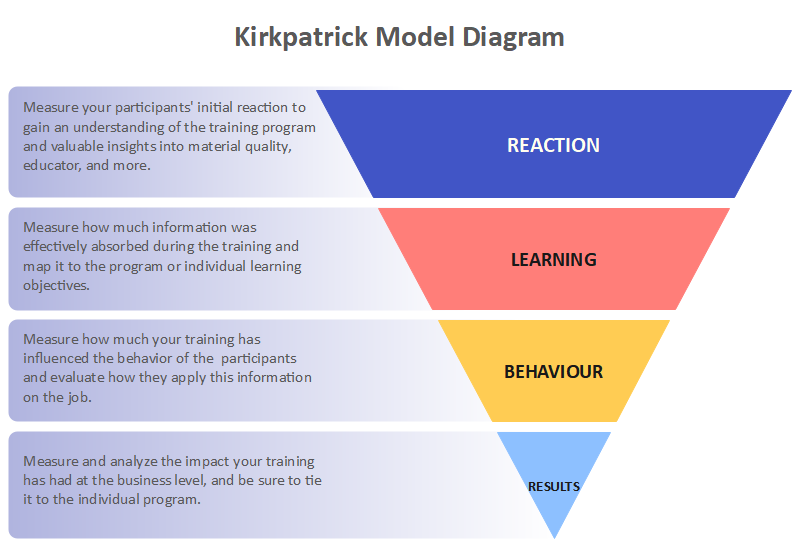
 Kirkpatrick Four Levels of Evaluation


The Kirkpatrick Model is a globally recognized method of evaluating the results of training and learning programs. It assesses both formal and informal training methods and rates them against four levels of criteria: reaction, learning, behavior, and results.

source


Further reading and resources:


These resources are sourced from online general search not a library database search.
I am including them here for further reading and critical analysis. The ET articles have references listed. 


Here is my next question to investigate
What are evaluation models?

(at some point 👻 )


Saturday, 29 April 2023

Instructional Design Models and Theories

What is Instructional Design?

In the article 'Instructional Design Models and Theories' Dr. Serhat Kurt lists the following key points on Instructional Design:
  1. Instructional design is learner-centered: Learner and his/her performance are the focal points.
  2. Instructional design is goal-oriented: Well-defined goals are essential.
  3. Instructional design focuses on real-world performance. Help learners perform the behaviors that will be expected of them in the real world.
  4. Instructional design focuses on outcomes that can be measured in a reliable and valid way. Creating valid and reliable measurement instruments is essential.
  5. Instructional design is empirical. Data are the heart of the process.
  6. Instructional design typically is a team effort. This process usually involves teamwork.
Source: https://educationaltechnology.net/instructional-design-models-and-theories/ Article posted on December 9, 2015 Updated onFebruary 17, 2021


ASSURE
Another article by the same author:
ASSURE: Instructional Design Model

ASSURE is an acronym for an Instructional Design model.

A – Analyse Learners
S – State Standards and Objectives
S – Select Strategies, Technology, Media, and Materials
U – Utilise Technology, Media, and Materials
R – Require Learner Participation
E – Evaluate and Revise


Apropos of nothing in particular - some ghosts I drew in 2018


Saturday, 1 April 2023

"Halfway through"

"Halfway through, What are Content type controls and language settings in your H5P.com trial?" 


Image: Sketch/draft of an illustration


H5P

I'm halfway through!??? That is my H5P free trial. I'm still finishing my Sketch course - among other things.  !!


Microlearning

Here, via ProQuest (thank you Information Management Masters for this handy knowledge), I am reading: Microlearning in the Digital Age 


UX

This image is about iterative design and is a UX designer's go to graphic. Image is from a LinkedIn post - on the UX Double Diamond. Suggesting ..another diamond in the iterative process. Interesting reflections in the comments.

I'll credit/source/link this during the week. 


Monday, 27 March 2023

I know you're going to love it, so let's dive right in!


An inky drawing (from ages ago) - I'll do some more


 "I know you're going to love it, so let's dive right in!"

That's introductory tutorial speak - and it works. I do feel enthused.


Language helps us to engage.

My current Sketch tutorial is very clear and concise and interesting. It helps me along if there is a real human engagement component to it.


Quick look RISE short video

plus this link to RISE article on the use of video in E-Learning. 6 Types of Video You Can Include in E-Learning

I am linking this here to remember to explore some of these aspects further. I like that you can embed, for example, Survey Monkey into a RISE build. I have had some fun creating surveys in Survey Monkey previously. I shall check... I can probably embed one in this blog.


ah.


Friday, 24 March 2023

SVG vectors and icons

I have many design resources bookmarked, but have decided to explore them a little more. These icons are all from SVG REPO, a site that houses svg icons that you can download and utilise in your UI designs (free) - easy to adjust many of them if you need to. I love the colourful critters...


This is me drafting a weather icon in Sketch

Earlier I was looking at redesigning my non-responsive website in Squarespace and then I remembered that Google has Google Sites. I may see how far I can push Google Sites with the aim of creating a monster, for the sake of process and learning, and then pivot to SquareSpace to maintain a 'professional skin' for my business.